 Amara Hartwood’s Official Website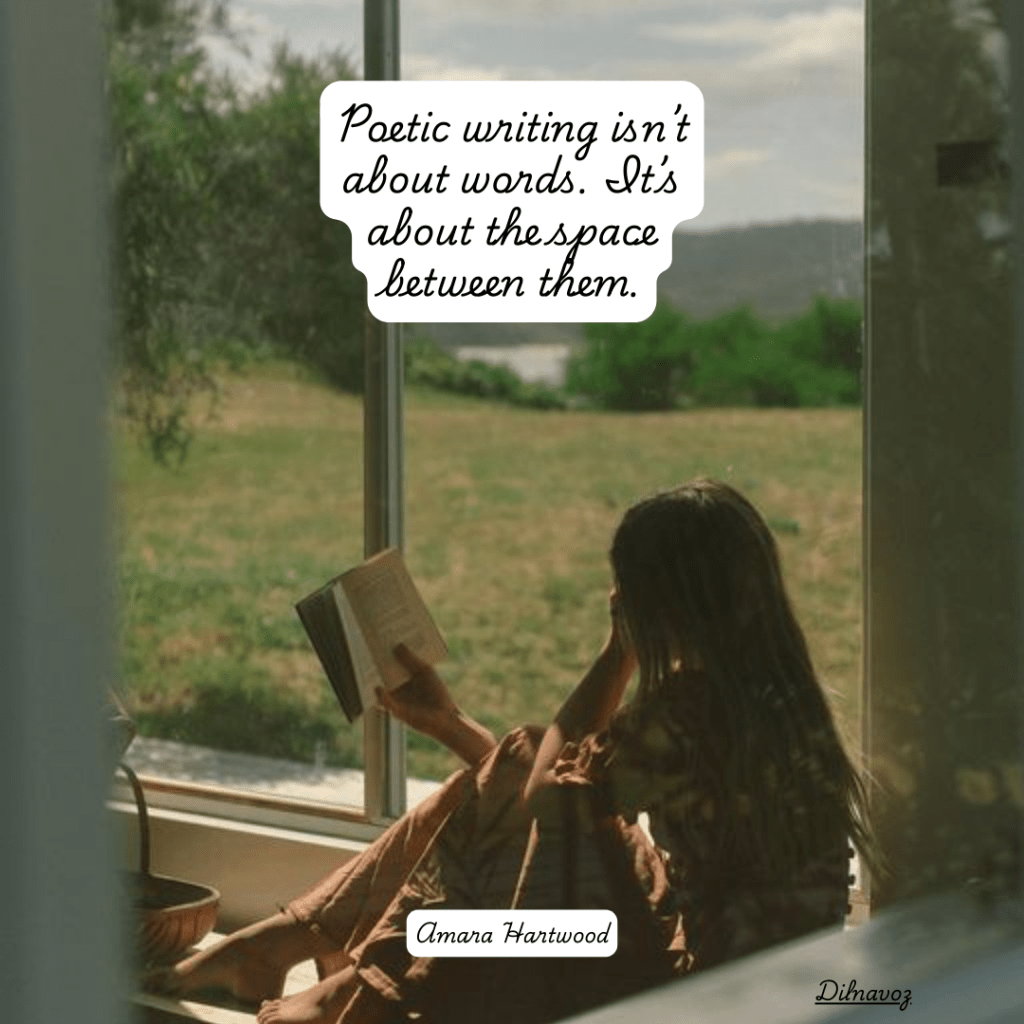
Want to write poetically? Discover how to use rhythm, imagery, and structure to create writing that breathes, moves, and stays with your reader long after the page is turned.
Poetic writing isn’t about dressing up words to sound pretty. It’s about rhythm, about feeling, about making words move in a way that makes people stop and feel something real. It’s about finding the heartbeat of a sentence, the weight of a pause, the breath before the next thought lands.
Why Poetic Writing Matters
The world moves fast. Words are thrown around, scrolled past, forgotten. But poetic writing makes people slow down. It makes them read a line twice, savor a phrase, sit with an image long after the page is turned. It’s the difference between a sentence that passes through and a sentence that lingers.
You don’t need to be a poet to write poetically. You just need to pay attention. You need to see the world differently and let that show up on the page.
1. Start with Observation: Become the Witness
Before you write, watch. Not just with your eyes, but with your whole being. Notice the way sunlight stretches across a wooden floor. The way a voice catches at the end of a sentence. The way rain sounds different on a tin roof than it does on pavement.
🖋 Try this:
Sit somewhere quiet. Watch. Listen. Don’t take notes, don’t rush to put it into words. Just take it in. When you do write, let it come naturally, like a memory surfacing.
2. Write with Rhythm, Not Just Words
A good sentence has a pulse. Some are short. Some stretch out, pulling you along, making you linger, making you breathe with the words. Then, suddenly, something sharp. A shift. A beat that stops you.
🔥 Example:
He left. The door stayed open. A gust of wind, and he was gone.
Or:
He walked away, slow at first, then faster, as if the air behind him pushed. The door stood open, a mouth frozen mid-sentence. Wind coiled through the space he left behind.
Both tell the same story. One is abrupt. The other lingers. The rhythm changes the experience.
🖋 Try this:
Write a short paragraph. Now, rewrite it. Play with the lengths of your sentences. Feel how the rhythm changes the mood.
3. Use Metaphors That Breathe
A bad metaphor weighs a sentence down. A good one expands it, opening up a new way of seeing. The best metaphors don’t just compare things; they reveal something deeper.
Consider:
❌ Her sadness was like a rock in her chest. (Heavy, but vague.)
✅ Her sadness sat heavy, like a stone abandoned at the bottom of a lake, forgotten, but still pulling her under. (Now, we feel it.)
🖋 Try this:
Take an emotion. Describe it three different ways. Make each one more specific than the last.
4. Leave Room for the Reader
Not everything needs to be spelled out. The most powerful writing lets the reader fill in the gaps. It trusts them to feel the weight of a moment without explaining it outright.
💭 Instead of saying, “She was heartbroken,” try:
She stared at her hands for a long time, as if waiting for them to remember how to hold something that wasn’t already slipping away.
See the difference? One tells. The other lets the reader step inside the moment.
🖋 Try this:
Write a scene where a character is feeling something deep, without saying the emotion outright. Let the details do the talking.
5. Make Your Writing an Experience
Poetic writing isn’t just about words, it’s about how those words feel. It’s about creating a moment the reader lives inside. It’s about taking something ordinary and making it unforgettable.
We are always observing, experiencing, creating. Writing is just capturing that process on the page. Everything you need is already in front of you. You just have to see it.
Final Thoughts: Your Poetic Voice is Yours Alone
Forget the rules. Forget trying to sound like someone else. Write in a way that feels true to you. If a sentence makes you feel something, it will make someone else feel it too. That’s all that matters.
Let your writing breathe. Let it unfold. Let it be poetry.
And let it be yours.
Want More? Let’s Keep the Conversation Going
🔹 Visit my website for more insights on poetic writing.
🔹 Subscribe to my newsletter for weekly reflections on poetic writing, creativity, and storytelling.
🔹 **Read more about poetic writing trends on **Poets & Writers
✨ Your words matter. Let them linger. Let them sing.

Leave a comment